
97
14323
The C2KO – Certified Crypto KYC Officer is a globally recognized crypto KYC certification trusted by VASPs, regulators, and financial institutions in 180+ countries. This program focuses on end-to-end KYC, CDD/EDD, and RegTech-driven onboarding practices, preparing you to meet the latest FATF and VASP compliance standards with confidence.
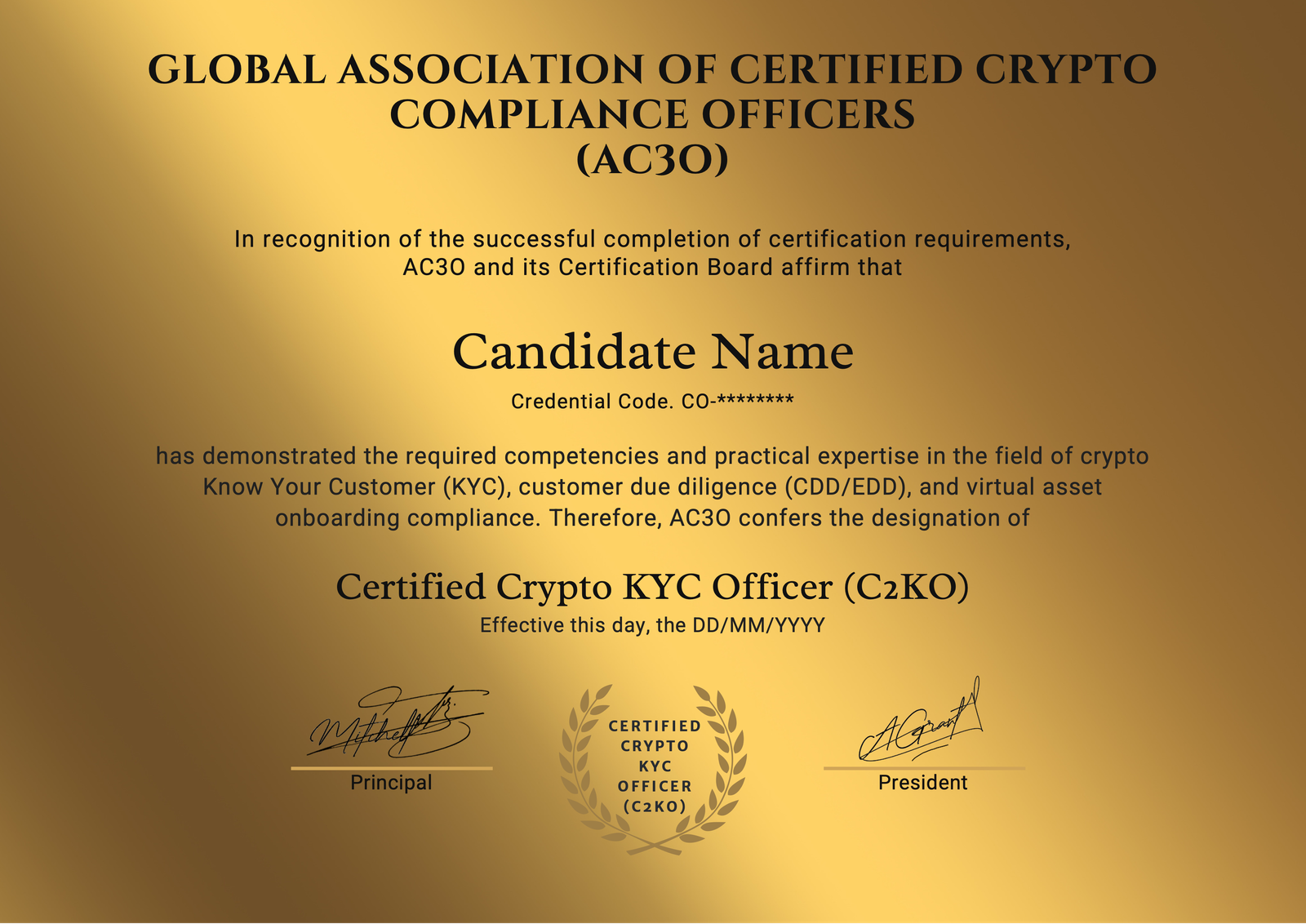
The C2KO – Certified Crypto KYC Officer™ is a globally recognized KYC certification program designed for KYC, CDD, and onboarding professionals working with virtual asset service providers (VASPs), crypto exchanges, and fintech institutions.
This program provides comprehensive, hands-on training on performing customer due diligence, enhanced due diligence, and identity verification within the fast-evolving digital asset ecosystem.
Accreditation
✅ Accredited by ONRIGA
✅ Blockchain-verified certificate
✅ Globally Recognized and Accepted in 180+ Countries
What You Will Learn
- Implement KYC/CDD frameworks tailored for VASPs and crypto institutions
- Verify customer and entity identities using on-chain and off-chain data
- Detect fraudulent identities, stolen credentials, and fake exchanges
- Apply FATF and MiCA-aligned onboarding and screening requirements
- Design customer risk assessment and ongoing monitoring workflows
- Leverage RegTech and automation tools for scalable KYC programs
Course Modules
Module 1 – Foundations of KYC in the Crypto Ecosystem
- Why KYC in crypto differs from traditional banking models
- Role of KYC within AML and CFT frameworks for VASPs
- Practical application of FATF Recommendation 10 for crypto businesses
- VASP licensing expectations and regulatory review focus areas
- KYC challenges in decentralized and semi-decentralized environments
- Common identity failures in crypto onboarding
- Case study on identity gaps leading to exchange penalties
- Practitioner perspective on how crypto KYC changes daily operations
Module 2 – Customer Identification and Verification (CIV)
- Individual customer identification in crypto environments
- Corporate and institutional customer identification
- Verifying wallet ownership and use of digital signatures
- Understanding wallet types and associated risk implications
- Ultimate Beneficial Ownership (UBO) in crypto-linked entities
- Beneficial ownership transparency challenges in layered structures
- Documentation standards under FATF and MiCA
- Case study on KYC breakdowns and identity-driven fraud patterns
- Practitioner guidance on acceptable versus unacceptable evidence
Module 3 – Customer Due Diligence (CDD) and Enhanced Due Diligence (EDD)
- Risk-based CDD for crypto customers
- Designing CDD workflows for individuals versus corporates
- Triggering EDD and escalation decision logic
- EDD for PEPs, sanctions exposure, and high-risk jurisdictions
- Source of funds and source of wealth assessment in crypto contexts
- Ongoing due diligence and periodic review cycles
- Building practical CDD and EDD risk scoring models
- Onboarding risk assessment templates and documentation standards
- Practitioner decision framework for CDD versus EDD
Module 4 – Screening, Risk Scoring, and Monitoring Tools
- Name screening for sanctions, PEPs, and adverse media
- Wallet screening and blockchain risk indicators
- Understanding limitations of KYT, KYC, and RegTech tools
- Integrating multiple data feeds without creating risk blind spots
- Identifying red flags in crypto customer behavior
- Escalation, review, and documentation best practices
- Continuous monitoring of customer and transaction behavior
- Case study on analytics-driven detection of mule accounts
- Practitioner judgment versus automated tool outputs
Module 5 – Regulatory Compliance and Data Management
- Record-keeping obligations for crypto KYC
- Data retention expectations under FATF and MiCA
- Data protection, privacy, and GDPR implications for KYC
- Managing cross-border KYC data and verification vendors
- Oversight and accountability of third-party verification providers
- Audit trails and evidence preservation
- Internal controls for KYC operations
- Coordination between KYC, AML, and fraud teams
- Preparing audit-ready KYC files
Module 6 – Governance, Audits, and Global Enforcement Trends
- KYC governance structures in crypto organizations
- Roles and responsibilities of KYC Officers, MLROs, and Compliance Heads
- Internal KYC audits and control testing
- Regulatory reviews and inspection readiness
- Global enforcement trends affecting crypto KYC
- Lessons from exchange and VASP enforcement actions
- ONRIGA-compliant KYC audit checklist
- Building a sustainable culture of compliance
- Practitioner expectations during regulatory scrutiny
Exam & Certification Details
Format: 100 MCQs
Duration: 90 minutes
Passing Score: 75%
Attempts: 2 included
Validity: 2 years (Renewal 20% fee)
Course Currilcum
-
- C2KO Official Study eBook Unlimited
-
- C2KO Final Certification Exam 01:30:00
Course Reviews
4.6
- 5 stars66
- 4 stars25
- 3 stars6
- 2 stars0
- 1 stars0
The C2KO exam was challenging but fair. I liked that it tested real understanding instead of memorization.
A must for crypto compliance professionals. The CDD templates alone justify the enrollment cost.
C2KO taught me how to properly perform EDD on high-risk customers. The real-world crypto examples are spot on.